Arctic Weather Alert
Wind has a major impact on whether exposed pipes freeze, even when the air temperature alone might seem marginal. Here’s how it works in practical terms:
1. Wind accelerates heat loss (wind chill effect)
- Wind strips away the thin layer of warmer air that naturally surrounds a pipe.
- This increases convective heat transfer, causing the pipe to lose heat much faster.
- Even though wind chills don’t lower the actual air temperature, it lowers the effective temperature of the pipe surface, making freezing more likely.
Example: At 28°F (−2°C) with strong wind, an exposed pipe can cool as fast as it would in much colder, calm conditions.
2. Pipes freeze faster in windy conditions
- In still air, pipes may retain some heat from:
- Residual warm water inside
- Heat leaking from nearby buildings or the ground
- Wind removes that heat continuously, allowing the pipe temperature to drop below 32°F (0°C) more quickly.
This is why pipes often freeze:
- On north-facing or windward sides of buildings
- In crawlspaces, attics, or under homes with air infiltration
- On bridges or elevated structures
3. Wind defeats insulation if it’s not sealed
- Insulation works by trapping air.
- Wind penetrating gaps or poorly sealed insulation nullifies its effectiveness.
- Even insulated pipes can freeze if wind is allowed to blow through or behind the insulation.
Key point: Insulation must be continuous, sealed, and wind-blocked to be effective.
4. Evaporative cooling can worsen freezing
- If moisture is present (rain, melting snow, condensation), wind speeds up evaporation.
- Evaporation pulls additional heat from the pipe, lowering its temperature further.
- This is especially dangerous around outdoor faucets and irrigation lines.
5. Why moving water helps—but wind can still win
- Flowing water resists freezing because it brings in heat from upstream.
- However, in strong wind and prolonged cold:
- Slow trickles may not provide enough heat
- Small-diameter pipes can still freeze
Practical mitigation strategies
To reduce wind-related freezing risk:
- Block wind exposure (plywood shields, skirting, or wind barriers)
- Seal insulation with tape or vapor barrier
- Use heat tape rated for outdoor use
- Enclose pipes where possible
Bottom line
Wind dramatically increases the freezing risk of exposed pipes by accelerating heat loss. In freezing weather, a windy 28°F night can be far more dangerous to pipes than a calm 20°F night.
There are several effective methods to keep your exposed pipes from freezing. Here are some of the most common ones:
- Insulation:
- Use foam pipe insulation, heat tape, or heat cable to wrap pipes.
- Make sure to cover all joints and bends thoroughly.
- Enclosures and Barriers: Build insulated boxes or enclosures around vulnerable pipes.
- Use plywood or other wind barriers to block strong gusts.
- Sealing Gaps:
- Seal any cracks, gaps, or openings in walls, floors, and foundations where cold air can seep in.
- Heating Solutions:
- Install a small space heater or heat lamp in areas with exposed pipes.
- Use heat tape or cables that are thermostatically controlled to maintain a safe temperature.
- Keeping Indoor Temperatures Consistent:
- Maintain consistent heat in areas where pipes are exposed, such as attics, basements, or crawl spaces.
- Disconnecting and Draining:
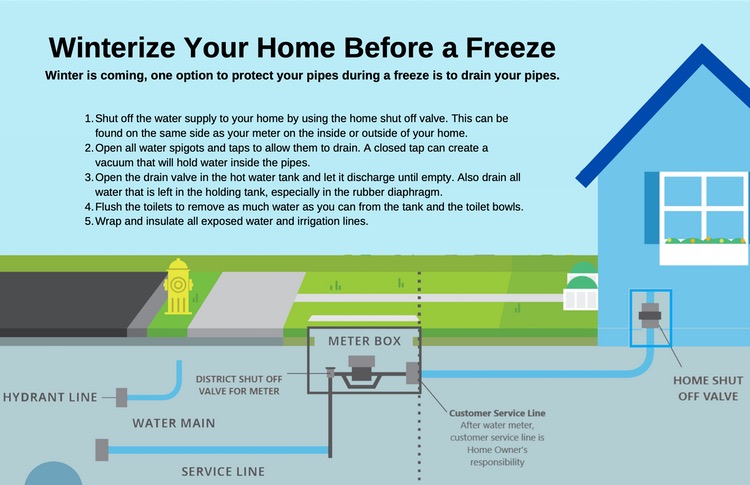
- For outdoor hoses and sprinkler systems, disconnect and drain them before freezing weather sets in.
- Using Outdoor Faucet Covers:
- Install insulated covers over outdoor faucets to help protect them from the cold.
By combining several of these methods, you can significantly reduce the risk of frozen pipes.
As a reminder from Winter Storm Uri, Senate Bill 3 was passed in 2021 which prevents penalties and water service terminations during an “extreme weather emergency.” This is defined as a period when the previous day’s highest temperature and the predicted temperature for the next 24 hours are both no higher than 28 degrees Fahrenheit.
Inframark will be monitoring the weather conditions and following the directives provided in SB3.